by Victor Dabby, Freelance
Presented at the Montreal 2009 Reunion, August 8, 2009
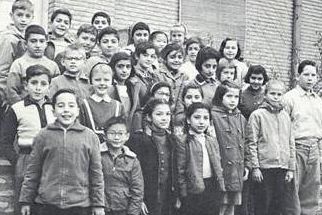
The author (fourth row, third from left) in Grade 5
They were the best of times, and the VERY BEST of times.
The Tehran that I knew, growing up in the 1950s and 60s, was a magical-mystery tour.
My first – and strongest memory – was of food.
Forever etched in my mind is the sweet smell of rose water in an icy bowl of faloodeh… at my favorite sweets shop on Pahlavi.
I cannot forget the joys of mixing butter with raw egg yokes and sumac in plateful of steaming rice… then digging into a chellow kebab…
at Shamshiri, the noisy, always-crowded, upstairs restaurant on Naderi.
Or ju-jeh kebab, hot off the charcoal grill, from the guy on a hillside, in Shemiran.
My greatest sin at age 16 – getting tipsy, drinking glass after glass of ice-cold ab-joh - or Persian beer - with a sandwich of kalbass –
pork – at the local Armenian food shop. A meal of pork and beer. Two sins in one.
Then there was my beloved nut store - next to the Cinema Diana… near Tehran University… on Shah Reza Avenue.
Storing up on salty tokhmeh, roasted watermelon seeds, then buying a ticket to the latest Jerry Lewis comedy, dubbed in hilarious Farsi…
was my idea of heaven.
My other memories:
Sleeping on the rooftop during hot summer nights, watching the stars.
Wandering around the sprawling rug market in the old bazaar.
Huddling around a bonfire while camping with the boy scouts at the foot of Mount Demavand.
Riding a dorosh-keh - a horse-drawn buggy – to go shopping with my mother on busy Lalelzar.
I loved Tehran. I loved the mountains that surrounded it to the north, and the deserts that stretched out to the south.
Back in the 1950s and 60s, it was a charming, slow-paced backwater city with only a couple of million people.
It had wide, tree-lined boulevards and mazes of narrow alleys - kutchehs – that stretched forever.
Many houses were surrounded by high brick walls… but inside those walls, were carefully-tended Persian gardens… a small pool and a
fruit tree.
But above all, to me, Tehran was Community School.
We had to drive deep into the city to get to the sprawling compound on Kucheh Marizkhaneh - Hospital Drive – near Jaleh street in
the city’s southeast.
We were at the heart of the downtown action, close to the Majlis or parliament buildings.
I would ask our driver - Gol Agha - to pass by the majlis now and then, to see if there was a hanging that day. Often, the body was
left in the public square, dangling till noon.
This was the dark side of Tehran. The light side was our school, a place where boys and girls, kids from at least 28 nationalities,
mingled freely.
We were Muslim and Hindu, Jewish and Catholic, Protestant and Zoroastrian, Bahaii and Russian Orthodox. We spoke Farsi and English,
Arabic and French, and a gaggle of other languages.
We were all cosmopolitans, raised on a heavy dose of idealism, big on the United Nations: we all knew the words to the official UN
anthem, Song of Peace, and regularly recited the pledge of allegiance:
"I pledge allegiance to my country, and to the United Nations of which it is a part, one world brotherhood of peaceful nations, with
liberty and justice for all."
We also grew up on a rich dose – some say overdose - of culture.
We staged Gilbert and Sullivan operettas. Recited poetry by Hafez and Saadi in Farsi class. Formed a choir to sing Christmas hymns
under the chandeliers of the Hilton Hotel.
Still, all around us, there was narrow-mindedness. Corruption. Repression. But we always had the feeling that we were somehow moving
forward and that we would all see a better world when we became adults.
The thought of leaving Tehran forever never crossed my mind. It seemed inconceivable that I would give all this up to live elsewhere.
But that is exactly what happened.
June 5th, 1963, was a Monday that started with just another math class.
Mid-morning, we heard the muffled sounds of roaring crowds and loud crackling noises outside the school gate.
Our school fire alarms started clanging and nervous administrators scurried in the halls, telling teachers to stop classes and bring the
students to the main auditorium.
There, we were told in solemn tones, not to panic, that there was "trouble" outside, that our parents were arranging to get us back home.
Meanwhile, the crowd noises were punctuated with gunfire. Someone whispered there was a mob at our school gate but police were there to beat
them back.
It felt like an eternity, but we were finally allowed out of the auditorium and into the courtyard to find our rides home.
I saw Gol Agha, our family driver, and ran to our yellow Opel sedan, happy to escape the madness.
Our drive home was surreal. Soldiers, troop carriers and tanks everywhere. Here and there, the burned-out wrecks of cars.
The half-hour drive home on Queen Elizabeth Boulevard… just off Shemran Road was tense as we slowed down at military roadblocks.
At home, I surveyed the city skyline from our balcony. There were plumes of smoke and the radio played martial music.
Then, a dusk-to-dawn curfew. My father joined me on the balcony, looked at the city and shook his head.
The next day, everyone talked about the "troubles." It seemed they were set off by the arrest of an obscure ayatollah who dabbled in politics.
It was the first time I had heard of a man called Khomeini.
It was the beginning of the end. Eighteen months later, we emigrated to Canada.
The unthinkable had happened. I had left my beloved Tehran to never return.
What happened to Community School during those last days was recounted to me by a student, who asked me not to use her name. She’s so
traumatized by her experiences.
She was part of the last graduating class of 1980. There were 125 students before the revolution, only 25 remained by graduation time.
The Community School campus was no longer safe. There were hostile crowds around the school gates. Fires were set. Then, the last straw:
Students from a neighboring boys’ school, climbed the walls and occupied the grounds.
Classes had to be moved to an embassy near Shemiran, far from downtown. Gone were the extra-curricular activities. Now, it was all work and no
play. There was fear in the air.
Someone from the American embassy came to the school to help students with applications to colleges in the U.S. He was among the hostages when
the American embassy was occupied.
To this day, no one knows if the hostage takers found the files and used them to compile a list of students who wanted to go to the United
States.
By coincidence, it was our old family driver, Gol Agha, who continued to transport students to the school with his private bus.
I remember this much about Gol Agha. He was a devout Muslim. He always carried a prayer rug in the car. Five times a day, he would stop
whatever he was doing, go by the side of the road, and perform his prayers.
He was a deeply religious Muslim who never made a big show of his faith. He just lived it. To this day, I still don’t know if he survived
the Revolution - or not.
Meantime, the students at Community school had to adapt to the new world order. Girls started wearing stockings, stopped using nail polish,
and little or no make-up - though they still resisted wearing headscarves.
Now, graduating became more difficult. Students had to learn the Koran and pass a test before getting their diploma.
A private teacher was hired, and eventually everyone passed the Koran test and got a degree. No one went back to the school after the final exams.
Now, it was time to escape. It took one year for this student’s family to find a smuggler. Only 18 years old, she left Tehran alone with the
smuggler and 11 other fugitives, to cross the border with Pakistan in the dead of night.
They made it to Karachi, then on to England, where she waited for her family. Five years later, they left Tehran with fake birth certificates.
She still loves Iran but remains shaken to this day, by what had happened. All these years later, she won’t speak about her experiences in public.
She was the final witness to the Community School saga… as it ended not with a bang but with a whimper.
Community School itself may have died, but its spirit lives on within each and every one of us.
It made us who we are today, and for that I am grateful.
Note: Victor Dabby lives in Montreal, Canada, with his wife and two daughters. You can write him at vdabby@sympatico.ca